View All e-News

MIGRANT GOD AMIDST MIGRANT PEOPLE

We are greatly disturbed of the frequent protests that are taking place in our country due to the implementation of Citizen’s Amendment Act (CAA), the proposed National Register for Citizens (NRC) and the National Population Register (NPR). People who have migrated from other countries long ago are living in fear as to whether the above exercises of the Government would affect their citizenship and if so where will they go to and what will they do? On the part of the government, they say it is a normal procedure but for many people who have no documents to prove their identity are living in fear as to their future! This situation in our nation led me to reflect upon an important and relevant theme “ Migration”. This made me to think further from a theological perspective and sharpen the theme as MIGRANT GOD AMIDST MIGRANT PEOPLE.

We live in a world on the move. In the global economy we voluntarily relocate for jobs, education, and social mobility, and people constantly relocate involuntarily due to oppression, conflict, and natural disasters. Sociologists have pointed out that displacement and migration have become the dominant themes of our age. This massive movement of people has given rise to all sorts of problems and fears. Assimilation has not always worked well: in some worst cases, multiculturalism has been accompanied by the emergence of xenophobic attitudes in segments of the population. Little wonder that the move now is towards various forms of protectionism and isolation.

Wrestling with these issues and undergoing positive social and political action is of paramount importance. However, I wish not to wrestle with modern issues of migration on a political level, but to explore the issue from a psychological and theological angle. I will begin with the psychology of the migrant experience seen through the eyes of the migrant, with illustration from my own migrant experience. From there, I will explore theological significance of migration, with the ultimate conclusion that our own experiences of migration should be understood in relation to the God who is himself a migrant.

In the physical sense, migration is simply the leaving of one place for another. But the emotional and spiritual reality—the inner shape—of the migrant experience is much more complex than the physical. Relocating a self that was formed and nurtured in one place to reside in a brand new environment will inevitably have a deep impact one’s sense of self. I am particularly reminded of my time in the United Kingdom to do my doctoral research. It was a different country in all respects and it was a painful experience for me and my family to adapt and adjust to the new situation in life, which was radically different from what we were used to in India. There were many occasions when we had to feel miserable due to our color and nationality. Even in the Church where I used to assist as a Curate, there were people who will not attend the Holy Communion Service if I were the Celebrant and there were people, even though they attended the Service will not receive the holy elements from me! There were many times during which questions like “ Who am I? “, “ Why am I here?” “ Why are people so racial and at times cruel in their dealings?” and so on. At the end of the day, we had to gather ourselves and reassess our priorities and move forward with complete dependence on God alone. Today, when I look back, I do not regret the experience of migration we had to go through in a foreign land. The experience taught us precious lessons in life, which we would not have learnt otherwise! Realizing priorities in life, facing people with different attitudes and perspectives with grace, accepting people as they are, discovering God as beyond but at the same time who is traveling with the dejected and the despised people, granting them the needed strength to move on in life.

Scholars have identified the first broad possibility of the migrant experience as being in-between two cultures. The idea is this: I will never be fully British and am no longer fully Indian: I am in the margins of both. Thus I am a “ divided self. This is basically a negative view and can lead to a problematic experience. The much more positive view is that I am in-both. Rather than seeing myself as being in neither, I live with the richness of complementarity and integration. Here is the beginning of the move towards new structure.

Living in-between can so easily lead to feeling alienated and marginalized, resulting in a victim mentality. But living in-both can lead to a celebration of a certain richness. The in-both mentality can allow one to view a new societal home from a different perspective—that of an insider-outsider. This applies not only to the migrant, but also to minority groups in a society. When I adopt the insider-outsider viewpoint, I don’t necessarily see things better than others—but I certainly attain a unique and valuable point of view.

Understanding the migrant experience from a psychological point of view is vital. But viewing the issue of migration from a theological angle is more powerful. I believe that we can and should call the God of the Bible a migrant God. A lot of our language about God is the language of distance: we speak of God as omnipotent and so on. But we also need to recognize the language of relationship. One-way to do this is to see God as the one who journeys with us.

The basic premise of a theology of migration is that God, in Jesus, so loved the world that he migrated into the far and distant country of our broken human existence and laid down his life on a cross so that we could be reconciled to him and migrate back to our homeland with God, and enjoy renewed fellowship at all levels of our relationships. Reading the Christian tradition from a migrant perspective involves perceiving what God is doing in the world through Jesus Christ and understanding God’s desire to cross over the barriers that divide and alienate our relationships.

Bible scholars identify four foundations of such a theology: the Imago Dei, crossing the problem-per- son divide; the Verbum Dei, crossing the divine-human divide; the Missio Dei, crossing the human-human divide; and the Visio Dei, crossing the country-kingdom of God divide.

These foundations give expression to the ways in which God reconciles the world to himself, breaks down the divisions in our relationships and helps us understand God’s movement into our world and our response to God’s grace. The notion of the Imago Dei (Image of God) emerges in the earliest pages of scripture, where we learn that human beings are not just what we label them, but people who bear God’s own image and likeness. If people on the move are only seen as migrants or workers, or worse, as lawbreakers, aliens or criminals, then their suffering makes no moral claims on us.

At the core of the problem-person divide is the experience of dehumanization. What migrants often say is most difficult for them is not the pain and suffering of the physical journey, as horrendous as it may be when crossing deserts or oceans and stowing away in trains and cargo containers. What hurts them most are the indignities, when people treat you like you are a dog, like you are a piece of dirt, like you are worth nothing as a human being.

The second theological notion central to the immigration debate is the Verbum Dei (Word of God). In the Incarnation, God, in Jesus, crosses the divide that exists between divine life and human life. In the Incarnation, God migrates to the human race, making his way into the far country of human discord and disorder, a place of division and dissension, a territory marked by death and the demeaning treatment of human beings. In Matthew’s account God not only takes on human flesh and migrates into our world, but God actually becomes a refugee when his family flees political persecution and escapes into Egypt (Matt 2:13-15). Jesus assumes the human condition of the most vulnerable among us, undergoing hunger, thirst, rejection and injustice, walking the way of the cross, overcoming the forces of death that threaten human life. He enters into the broken territory of human experience and offers his own wounds in solidarity with those who are in pain. The Jesus story opens up for many migrants a reason to hope, especially in what often seems like a hopeless predicament. If the Verbum Dei is about God crossing over the divine-human divide, the mission of the church, or the Missio Dei (Mission of God), is to cross the human-human divide. This Missio Dei proclaims a God of life by building up, in a civilization of love.

Finally, the Visio Dei (Vision of God) is about looking at the world in such a way that the kingdom of God shapes our vision about who we are in the world. It acknowledges the role of national identities but recognizes that the deepest allegiances of Christians are predicated on a mission of reconciliation, meaning that the borders that define countries may have some relative value but are not ultimately those that define the body of Christ.

Theology offers not just more information but a new imagination. It supplies a way of thinking about migration that keeps the human issues at the center of the debate and reminds us that our own existence as a pilgrim people is migratory in nature. Christian discipleship leads us to overcome all that divides us in order to reconcile our relationships, reminding us that the more difficult walls to cross are the ones that exist in the hearts of each of us. We are unable to cross these divides by ourselves. Christian faith rests ultimately in the one who migrated from heaven to earth and, through his death and resurrection, passed over from death to life.

God self-identifies as the wandering God: “but I have been moving about in a tent for my dwelling” (2 Samuel 7:6). This wandering aspect of God is one of the reasons Samuel is so concerned about David’s desire to build a temple for Yahweh.

God is the God of the journey. This is most clearly expressed in God’s journey with his people as a cloud by day and a pillar of fire by night (Exodus 13:20-22). God is the exiled God: the glory of God leaves the temple (Ezekiel 8:1 to 11:25) and God joins his people in exile. God as the migrant God is clearly seen in the NT narrative: for example, Jesus’ refugee status in the flight from Herod’s killing fields; Jesus’ marginal status as coming from the rogue province of Galilee; his non-professional status in the hierarchical society of his time; his itinerant ministry in Palestine; his subsequent transition from outskirts to the Centre of power in Jerusalem; and, most centrally, his migration into human form in the incarnation.

The first and most obvious thing that should be said is that our life’s experiences are not to be negated but need to be brought with us in our reading of Scripture, our prayers, and our engagement with the wider world.

Some of life’s experiences are more significant than others and, therefore, have been more formative. We need to make such experiences productive. In my case, being a migrant has been a blessing. It has made me aware of loss and gain. It has made me open to the other, to those who are strange and different. It has made me somewhat comfortable with ambiguity and liminality. And, as I have already indicated, it has brought me into contact with the God on the road rather than simply the static God in the temple.

You may feel at this point: “what on earth has all of this to do with me? I am not a migrant; a migrant’s experience is his / her own.” So let me then make the point: any experience that disassembles us, strips us bare, and takes us out of our comfort zone can be approximate to the migrant experience. And whether that be a relationship breakdown, loss of a loved one, a job loss, or a health crisis, one can end up in a sort-of no man’s land.

It is at this point that we need a messy, rather than a tidy God. We need God in the tabernacle, not the temple. We need a God in the midst of our ambiguity, pain, lament, confusion, and questioning. We need a God at the margins. We need the migrant God. And we need to make our times of vulnerability productive—to allow them to help us realize our true condition in the world, and to open us to respond to others who are hurting or on the margins. God of the Bible is a Migrant God Amidst Migrant People!

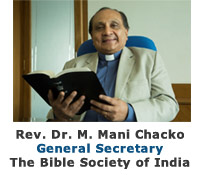
Rev.Dr.M.Mani Chacko,Ph.D(Lond.)
General Secretary
The Bible Society of India

Read more

BSI Distributes Bibles and Tracts at Quarantine Centres

The Bible Society of India, Dimapur Auxiliary distributed 221 ESV Bible and Bible Tracts at quarantine centres in Dimapur on the 20th of May through the Nagaland Covid19 core committee members at the reception centre, Agri Expo (Dimapur Quarantine Centre).

A Press release from the BSI Auxiliary Secretary, Rev. Dr. Yiepetso Wezah stated that, in the midst of fear and anxiety during the pandemic, there was hope and comfort in Jesus Christ and that the Bibles were distributed to encourage the old timers who returned back to the Word of God.

Earlier, Rev. Dr. N. Paphino, President and Rev. Dr. Yieptso Wezah, Auxiliary Secretary with staff handed over Bibles to the core committee members and offered prayers for the front-line workers.

The BSI Dimapur Auxiliary thanked Rev. Dr. M. Mani Chacko, General Secretary, and Mr. Paul Stephen, Director, Publishing and Marketing Department for their acknowledgement and support.

The BSI, Dimapur Auxiliary lauded the Nagaland COVID 19 core committee team members for going the extra mile towards containing the spread of Covid-19 in Nagaland.

Read more

CENTRAL COUNCIL MEETINGS

Every three years the Executive Committee of the BSI along with the delegates from the BSI Auxiliaries across the country gather together to assess the Bible work and work on strategic direction for the next triennium . The Central Council consists of the Executive Committee, the office bearers of the Auxiliaries, and delegates representing the Auxiliaries across the country.

This year about 115 delegates gathered for the 27 th  Triennial Central Council meeting in Bangalore.   As many as 16 youth representatives (under 30) attended the council for the first time.

The theme of the Central Council was Philadelphia Promise:  Resourcing the vision and mission of the BSI. The key characteristics of the Philadelphia Promise are:

  • Focus on Audiences and their representation in our programs
  • Strengthen Church Relations and build new relationships with Churches not involved in our work
  • Share resources such as expertise, talent and scholarship with neighbouring Bible Societies
  • Mobilise resources to Support Bible work in needy areas
  • Integrate digital into our Mission to reach new audiences generating greater engagement
  • Promote succession planning and talent management
  • Increase Sustainability, minimise waste and maximise impact
  • Develop Wholistic Programs to meet total needs persons or of communities

It was a privilege to have Rev.Dr.Robert Cunville, President, UBS, Mr. Michael Perreau, (Director General of UBS) along with Rev.Dr.Roy Pererson (the President and CEO of ABS) at the Central Council meetings.

A good number of leaders from various Bible Societies and denominational Churches brought Greetings and Goodwill messages:

a) The Most Revd. Dr. Joseph Mar Thoma, Metropolitan, Malankara Marthoma Syrian Church
b) The Most Revd. Dr. Yuhanon Mar Chrysostomos.Metropolitan, Malankara Orthodox Church
c) The Archbishop Felix Anthony Machado, Bishop of Catholic Diocese of Vasai, Mumbai
d) The Revd. Dr. Mar Atsongchanger, Executive Secretary,Ao Baptist Church Association Mission Centre
e) Mr. Alwan Masih, General Secretary of the Church of North India Synod
f) The Revd. Liton Mrong, General Secretary, Bangladesh Bible Society
g) The Revd. Mathew K. Punnoose, General Secretary, Malaysian Bible Society
h) Dr. Julian Sundersingh, Ministry Resource Facilitator& Global Literacy Coordinator, Global Mission Team: Global Ministry Exchange
i) The Revd. Daniel Cheng, General Secretary, Bible Society of Taiwan

The General Secretary and the Directors presented their reports of the respective departments.  They also presented their strategic plans for the next 3 years.

The work of the BSI Auxiliaries were appreciated and awards were presented for “Excellence in contribution and distribution”.

1. Aizawl Auxiliary received the award of excellence for raising contributions.
2. Tamil Nadu received the award of Excellence for Bible Distribution
3. Kerala Auxiliary received the Award of Excellence for Overall Performance

Awards of Appreciation was also distributed to the Auxiliaries in recognition of their Bible work.

The Central Council also elected the Most Revd. Dr. P.C. Singh as its President, Dr. Mrs. Leela Bose – as Vice President and Revd. Premkumar Soans the Treasurer.

The Outgoing Office Bearers, namely, President, Vice President and Treasurer were honoured for their faithful service.

To God be the glory for all the great things that God did in and through the Bible Society of India Team during the Triennium, as well as what God is going to do during the next Triennium.

Read more

I Love Reading the Bible

“Do you have Genesis, Exodus and other Old Testament books in Kannada Braille?”, enquired Thimae Gowda on the phone. Thimae Gowda is one of the many visually challenged people who receive Braille Bibles from the Bible Society of India. “ Yes, we do have Genesis and a few other Old Testament books in Kannada Braille”, we replied. Thimae Gowda was immediately overwhelmed with joy. We could easily feel his excitement in his voice over the availability of the books of the Bible he has been wanting to read. “I will come and get it from the BSI office when I come to Bangalore”, he said. Thimae Gowda came to our office yesterday from his native place Tumkur and received the 5 books he wanted in Kannada Braille.

Many visually challenged people are benefitted by the distribution of Braille Bibles in many Indian languages. The Braille Bibles are also posted to those who are unable to come to the office. Santhalingam, a resident of Chennai recently received I & II Samuel and I & II Kings in Tamil Braille from the BSI office by post. “ I am thankful to BSI for helping me with the Braille Bible”, said Santhalingam when he called us after receiving the Braille Bibles. Some even make requests for Braille Bibles on behalf of someone whom they know and we send them the Braille Bible in the language of their choice” says Immanuel. Loganathan, who completed his study from the Blind School in Poonamallee contacted the Bible Society through his friend in Bangalore. Loganathan was able to receive Braille Bible books that he wanted to read.

The Braille Bible is quite voluminous. In fact, it is 43 volumes in all. And so, visually challenged people receive the Bible as books. We are really happy to serve the visually challenged. Most of them who contact us are eager to read God’s Word. We are touched by their love for the Bible”, says Immanuel, a staff of the Media and Special audience Department. The Braille Bible is quite expensive too and not many can afford to buy the Braille Bible. The Bible Society of India makes available free Braille Bibles for the visually challenged in many Indian languages.

Lemu, a visually challenged student at the United Theological College, Bangalore requested the Bible Society for the Braille Bible. He finds the Braille Bible very helpful for his studies. He now regularly contacts the Bible Society for the various books of the Bible in Braille. We are very extremely happy at Lemu’s eagerness to make the Bible available in Braille in many of North Eastern languages spoken in Churachandpur

The BSI is committed to serving the visually challenged. We see this as an opportunity and privilege. If you know of any visually challenged person who is in need of Braille Bibles please contact the Media and Special Audience Department at bsisa@biblesociety.in

Read more

Diamond Jubilee

Valedictory Ceremony, Kottayam

The Kerala Auxiliary was inaugurated with the motto, Bible for every Christian home in Kerala and has faithfully served the Bible cause for the last 60 years. The year 2016 – 17 marks the Diamond Jubilee of the Kerala Auxiliary. The Kerala Auxiliary has served the church in Kerala, particularly in meeting her Scripture needs, supporting gospel outreach, and providing a platform for common witness.

The Kerala Auxiliary celebrated its Diamond Jubilee Valedictory Ceremony on the 9th December, 2017 at the Jerusalem Marthoma Church, Kottayam. The Diamond jubilee Celebrations were concluded at the 61st annual meeting of the Bible Society of India, Kerala Auxiliary. The function was graced by the presence of Rt.Rev. Joseph Mar Barnabas Episcopa (President), H.E. Kuriakose Mar Sevarios, H.G. Mathews Mar Aprem ( Vice President) and several other dignitaries. The Annual meeting was attended by the officers of the BSI branches all across Kerala.The newly produced Malayalam Audio Bible was released during the meeting.

Our prayers are with the Kerala Auxiliary as they renew their commitment for the Bible cause and continue on in the faithful journey for the last 60 years. We congratulate Rev. Mathew Skariah, Secretary, Kerala Auxiliary and his dedicated team for organising this grand event.

Read more

Odiya Audio Bible Release Function

Odiya Audio

Today, there is a growing preference for ’listening’ rather than ‘reading’ and the numbers are rising exponentially. The trend is not just with people who can’t read but also with the ‘neo-literates’ and ‘non-readers’. The audio Bible comes handy for people who would rather listen than read. Besides, the Audio Bible is a welcome tool for the people ‘on-the-go’ and the the elderly who find it extremely difficult to read small print.

The Bible Society of India has been producing audio Bibles in many languages. The Odia Audio Bible was recorded by a team of dedicated staff and volunteers led by Rev.Dr. Ashish Patro, Secretary, Odisha Auxiliary. The Odia Audio Bible was released on 18th December 18t at the CNI Baptist Church, Cuttack. The release function was well attended by Christian leaders and believers drawn from all denominations. The BSI Standing Choir, Shillong ministered to the congregation through music and song.

The Media and Special Audience Department congratulates the Odisha Auxiliary for the successful completion of the Audio Bible project and releasing the Audio to benefit those who are in need of the Audio Bibles. We hope and pray that the Odia Audio Bible will be a great blessing to the Church in Orissa.

For further details about the Odia Audio Bible please mail to: bsiori@biblesociety.in

Read more

JOYCE Pallat Retirement Programme

It’s been 40 years since Mr. Joyce Pallat joined the Bible Society of India. Mr. Joyce Pallat retired on 28 November 2017 after his distinguished service as Asst. Director, Internal Audit Department of the Bible Society of India.

What made you join the BSI?, I asked him just a few days back before his retirement. “It was my passion to serve Christ. My father was a pastor and therefore, I wanted to serve God. I refused a bank posting and joined the BSI in 1978”, he replied. “ But… I have been blessed in every way. I have no regrets”, he continued after a little pause.

He then told me how he enjoyed working with the BSI, first with the finance department and then later with the Internal Audit department. “When I joined BSI we were not this big. Today we have established ourselves. We have moved from strength to strength. Of course, we had gone through difficult days and trying times. But, God has been faithful to the BSI. No one can stop the work of the BSI”.

You could feel the joy ebb in his heart as he reflected on the last four decades in under four minutes. Mr. Joyce Pallat recognises the role played by the Bible Society of India in his life and ministry. “If you see most of the BSI staff retire after 25 years, 30 years and that tells a lot about BSI as an organisation”, he said. Every time he mentioned BSI you could see him gleam with pride.

I asked him about his future. “ We plan to settle down to a much quieter life in Mangalore”, he replied. Mr. Joyce Pallet, like many before him, have faithfully served the Bible cause through the Bible Society of India.

He will surely be missed. We wish him all God’s blessings and thank and celebrate God for his service with the Bible Society of India.

Read more

UMMEED- Celebrating Christmas

THE BIBLE SOCIETY OF INDIA
NORTH WEST INDIA AUXILIARY
NEW DELHI

The Bible Society of India, North West India Auxiliary organized UMMEED Christmas with the vulnerable at the Community Centre, Gole Dak Khana, New Delhi on the 4th December 2017. Around 250 children from as many as 15 organizations participated and presented Christmas program through singing, dance and skit. They included Children with disability; children rescued from human trafficking; children infected with HIV & AIDS; visually abled and children from the weaker socio-economic strata.

The Chief Guest for the event, Dr. Mrs. S. M. Rao, Treasurer, NWIA and the Guest of Honour Monsignor Fr. Susai Sebastian, Auxiliary Member encouraged children with a meaningful Christmas message. They were welcomed with a potted plant by Rev. Shirley Lall, Auxiliary Secretary, NWIA.

All the participants were gifted with ‘The Children’s Bible’ sponsored by the United Bible Societies, through The Media Department, The Bible Society of India. Chocolates sponsored by Nestle, and other gifts sponsored by the well wishers of NWIA. Braille Bibles were distributed to the visually abled children.

The children and the guests enjoyed a good lunch too. The event was an amalgam of the joy, love, and hope that the birth of Jesus Christ brings. It was indeed a heart warming and blessed event.

Read more

The Khasi Braille Bible

“I have longed to read the Bible. Not just hear the Bible being read to me. I have been praying hard for a long time. I am happy that the Khasi Braille Bible is being released. Now I can read the Bible for myself”, said Sister Bertha G. Dkhar to the packed audience at the Dinam Hall, Shillong. It was indeed a joyous occasion for us and many like her, as the first Khasi Braille Bible (Psalms and the Gospel of Matthew) was released on 5th April 2018 at an event hosted by the BSI Shillong Auxiliary at the Dinam Hall, Shillong.

The request for the Khasi Braille Bible came to the Bible Society of India from the Khasi Jaintia (KJP) Presbyterian Synod. We are thankful to Rev. Phidolis Dkhar, Secretary, BSI Shillong Auxiliary, and the staff of BSI Shillong Auxiliary for taking up this project and completing it within a very short period. It was truly yet another opportunity for the Bible Society of India to serve the Church and be a servant in God’s Mission.

The release function was attended by many church leaders, Branch leaders and supporters of the BSI. The guests of honour who graced the occasion were Rev. H.L Marsing (Moderator of Ri Bhoi Presbyterian Synod), Rev. Imiong (Executive Secretary Church of God,Meghalaya&Assam), Most Rev D Jala, Arch Bishop of Shillong Diocese(Roman Catholic), Ms Bertha G Dkhar, Sr Coordinator (MDUE), Rev. S.S. Majaw (Moderator of KJP Assembly), Most Rev. Dr. Purely Lyngdoh (Former Moderator of the Church of North India), Rev. Dr. S.D Kharmawpllang ( President, BSI Shillong Auxiliary), Elder.K. Lyngkhoi (Vice-President, BSI Shillong Auxiliary) and Rev.Z.M.Sawkmie (Translations Advisor, Translations Centre, Shillong).

The first copies of the Khasi Braille Bible (Psalms and Mathew’s Gospel) were released by Mr. Samuel Thambusamy, Director for Media & Special Audience, Bible Society of India. The new Khasi Bible will help PVD’s to access the Bible. Besides, it will also help them to actively participate in Church services and thereby genuinely be ‘included’ in worship. We are particularly thankful to the Bethany Society, Sister Bertha G. Dkhar and Compass Braille International for their work and ardent support in completing the book of Psalms and Matthew’s Gospel in Braille.

Mr. Samuel Thambusamy reiterated BSI’s commitment to serve special audiences and promised that the other books of the Bible will be made available in Khasi very soon. Sister Bertha thanked the BSI for releasing the Khasi Braille Bible as it will reach to the many who are waiting to read God’s Word. Sister Bertha’s love for the Bible and the passion to make the Church an inclusive community left a deep impression among the participants. Music and Songs rendered by Ms. Lodina Rani & and the other visually challenged students from the Bethany Society warmed everyone’s heart.

Many PVDs are poor and have very little access to God’s Word. As BSI, we are very happy to be of service to the faithful who are in need of Braille Bibles. One full Braille Bible is made up of at least 40 large books and is very expensive. The Bible Society of India through the Special Audience department reaches out to PVDs by providing them Braille Bibles for free, thus making the Bible available and accessible to them

For further details about Braille Bible please mail to: bsimedia@biblesociety.in

Read more