THE GREAT COMMISSION TEXT AND THE MISSION OF GOD IN THE NEW NORMAL
The Great Commission Text in Matthew 28: 18-20 is the key text for our engagement in the Mission of God. The Church around the globe and the various mission bodies had been caught up with the mandate for mission inherent in this text. Our nation is no exception when it comes to the presence of missionaries spreading the Gospel of Jesus Christ. The text has become a foundational text for aggressive missiology underlying new evangelical movements in the sects and main-line Churches. The text has been used and abused over the years and hence a flawed understanding of mission was developed forgetting or ignoring other important dimensions of mission. In the New Normal and beyond the New Normal what we are experiencing today, how we understand the Great Commission Text and the Mission of God is of utmost importance.
1. The Great Commission Text
The text concludes the Gospel of Matthew, which is regarded as the most meticulously constructed writings of the New Testament. It is a worthy finale to the Gospel. As scholars have pointed out, it is a summary of the whole Gospel by weaving together its Christological (Mt.28:18), Ecclesiological (Mt.28:19-20a) and Eschatological (Mt. 28:20b) threads into a carefully crafted composition, whose theological density rivals that of the prologue of John.
There are two parts in the text: an introductory narrative featuring eleven disciples (vs. 16-17) and a solemn announcement of Jesus (vs. 18-20). It is often argued that the event is a post-resurrection appearance of Jesus. There is nothing in the Gospel of Matthew to suggest that it was the risen Lord who had appeared to the disciples. All the elaborate process of the verification of the reality of the body of the risen Lord, which is profoundly explained in Luke and John, is missing in Matthew. Here the focus of the story is not on appearance of the risen Jesus, but on the message he gives. The message takes the form of a three-step proclamation – a revelatory statement (vs.18), a mission command (vs.19-20a) and the promise of the divine presence (vs.20b).
There were attempts made to identify the literary form of the text. It has been variously compared, (1) to an Ancient West Asian enthronement ritual, which contained three successive actions, (2) to a type of `divine pronouncement’ comprising of three elements as found in several Old Testament texts like Exo 20 or Deut 5, (3) to the form used in Old Testament stories of the commissioning of charismatic leaders like Moses in Exo 3:4-12, (4) to an `official decree’ like that of Cyrus in 2 Chron 36:23, (5) to the `covenant formula’ derived from the Hittite suzerain treaties and widely used in the Old Testament covenant texts, (6) and to the “I am sayings of Jesus”. Although the above models are possibilities that may have influenced the writer of the Gospel of Matthew, it is very unlikely that he was following a precise literary model in the Great Commission text. The text could be seen as a natural expression of a commissioning through a transcultural functional `genre’, which can generate similar texts in different contexts. It is, therefore not necessary to locate the text in a particular Jewish or Hellenistic setting or model.
Coming back to the three elements that shape the text, it is clearly the mission command (vs. 19-20a), which is central. Both the revelatory statement (vs.18) that precedes and the promise (vs.20b) which follows it, reinforce the command. The command has four verbs. Of the four verbs three (going, baptizing, teaching) are qualifying participles. Only one, “making disciples of” of “disciple” is a finite verb, and contains the main imperative of the command. For Matthew, to engage in mission is to strive to make “all peoples” disciples of the risen Lord. The universal mission to make disciples is to be achieved by baptizing them and by teaching them to observe what Jesus had commanded. It is a portrayal of the emergence of a new community that is emerging through a new rite of initiation, which replaces circumcision and through a new kind of teaching, the core value of which is love (Mt. 22:40). The accent here is not on the “going out” but on “teaching” and thereby “making disciples.” Baptism is to be seen only as an outward symbol of the inward transformation that is taking place. To treat the text primarily as a commission text mandating Christians to a universal mission is outside the scope of Matthew. The tendency to make the text as the Great Commission text is a later development of the colonizing mentality that was prevalent in history. The basic thrust of Matthew is to build an alternate community based on the teaching of Jesus and the focus is not on the “going out” or “baptizing.”
2) Interpreting the Great Commission Text and the Mission of God
The Great Commission text had been taken out of its context and read as an autonomous decree. The text, which is an editorial masterpiece, is now read as a simple `Great Commission’. The text is a worthy finale to the Gospel of Matthew and if so, it should be read as a part of the entire Gospel and not in isolation from other equally important texts. Such a reading of the text is dangerous and can lead us to a damaging missiology. Mission is no longer seen as the spontaneous and joyous communication of the experience of the risen Lord. Rather it is now seen as a `duty’ imposed on people. Mission fueled by triumphalistic statements degenerates into a `conquest’ where the numerical expansion of the Church or political or economic advancement of its leaders become the goal. Mission ceases to be an act of service and becomes a selfish exercise of survival, expansion and power. A corrective to this understanding of mission can happen provided we engage in Biblical interpretation with utmost seriousness keeping in mind it is the God of the Bible and not the Bible itself that we need to focus on in our reading and interpretation of the Bible. The following two hermeneutical methods or principles would be of help in such an attempt.
a) Integrated Reading
The Great Commission text needs to be read along with other texts such as the Mission Discourse in Matthew 10: 1-42, and the largely neglected mission command found in Matthew 5:13-16. The first text talks about Jesus’ mission instructions to his disciples as to how they should conduct themselves when they engage in God’s mission. Those involved in mission are called to a life of missionary discipleship and not just a commissioning to missionary activity. Such a life calls for a radical detachment from possessions and family ties, a radical trust in God and a radical fidelity to Jesus in all conflicts and persecutions that they would encounter. Mission, as Matthew understands it, is not a `command’ by means of which Christians are forced into some reluctant activity. It is not an enterprise that depends on human resources. But rather, it is carried out in poverty and powerlessness that depends on God alone. The `Great Commission’ text when read with the Mission Discourse in Matthew 10 challenges us to engage in God’s mission in a spirit of poverty and powerlessness.
The other text of significance is Matthew 5:13-16. This text gives us an understanding of mission which complements that offered by the Great Commission. In it, mission is described in terms of being or witnessing than verbal proclamation. This dimension of `being’ or `witnessing’ strives not for `Church growth’ but for the wholeness of creation. There is also a communitarian dimension inherent in this text, which is often overlooked. The mission command in 5:13-16 is not addressed to individual followers of Jesus but to the Christian community as a whole. It is this community that is supposed to be the salt of the earth and the light of the world. Any verbal proclamation to be authentic must be lived out in the Christian life of the community. This text also underlines yet another forgotten or ignored dimension of mission. It powerfully advocates the view that the mission command is not Ecclesio-centric nor Christo-centric but Theo-centric.
The ultimate aim of mission is to lead people to give glory to God and this happens when we contribute to the establishment of the Reign of God on earth. The aim of mission here is not so much planting the Church, nor conquering the world for Christ nor fostering Church growth, as leading history to its fulfillment in the full realization of the Kingdom of God. This understanding of mission is relevant to our context today. Our missiology should be centered on God rather than on the Church or even Christ. Such a theo-centric focus is nothing to be embarrassed about, for it is very much biblical. The biblical story begins and ends not with the Church nor even with Christ but with God who is all in all. Thus this mission command offers a double corrective to the flawed understanding of mission. Firstly, it extends the aim of mission from a narrowly Ecclesio-centric or Christo-centric to a fully Theo-centric one and that is building up of the Reign of God on earth. Secondly, it shifts the emphasis of missionary praxis from individual proclamation to prophetic community witness.
The integrated reading of the biblical texts helps us to understand mission in a holistic manner bringing to light different dimensions of the text, which otherwise would have been hidden from us. The realization of such mission perspectives helps us to have a balanced understanding of God and God’s mission. This in turn helps us to look at our neighbour not as an object of evangelization but as a fellow human created in God’s image. This outlook of life will enable all of us despite our varied faith affiliations to work together in making the world a better place to live in.
b. Perspectival Reading
Another method we can employ in the reading of the Bible is to read the texts with a perspective. The perspective I adopt in my readings is the perspective of life. The central message of the Bible and of Christ, I believe is life in all its fullness and abundance. It is from this perspective I engage in biblical interpretation. When we view the Great Commission text from this perspective of life, it is to be noted that the Great Commission is given in the context of another military expansion that was happening, i.e., the expansion of the Roman Empire. Jesus’ commissioning of his disciples to a worldwide mission was taking place in the context of another worldwide mission that was already operative, the mission of the Roman Empire. That was the time when the Roman empire was engaged in a ruthless mission to dominate the entire world and bring the world under its authority and dominion. Anyone who challenged or posed a threat to the Roman rule was eliminated mostly by crucifixion. When Jesus was born and Herod came to know that the “King of Israel,” a possible threat to the Roman authority was born, he wanted to eliminate baby Jesus. Later on at the time of crucifixion, Jesus was repeatedly mocked as the “King of Israel” to show what would happen to anyone who challenges the Roman system. The Romans believed that their empire was founded by the divine orders and its mission to dominate the world was entrusted to them by the gods. The emperor was not just to be obeyed but also to be worshiped as he was divine. Thus, a Roman imperial theology was promoted by all agents of the empire.
Jesus was convinced that this worldwide mission of the Roman Empire was opposed to God’s purposes. As soon as the news about the resurrection of Jesus began to spread we see the operation of the empire – the guards were bribed by the chief priests, the agents of the Roman Empire, and they were asked to propagate an alternate story of lies saying that the body of Jesus was stolen by his disciples to counteract the fact that Jesus rose from the dead, which would be a threat to Roman imperialism. Immediately after reporting about this ploy, Matthew reports about the declaration of Jesus, “All authority in heaven and on earth has been given to me….” Under God’s authority given to Jesus, people were healed, fed, taught and freed from a life of fear and dehumanization to a life of fullness. Jesus commissioned his disciples to proclaim God’s empire to everyone on this earth and make more disciples who would carry on the work of enabling people to experience that life of fullness that was available to all. Jesus commissions his disciples to make more disciples who would resist all claims to pledge their loyalty to no one else but to God and act as agents of God’s reign of peace, justice and fullness of life. New disciples are to be initiated into such a new community of resistance by baptism. Baptism is a stamp that signifies the transfer of loyalty to God’s authority from allegiance to other empires such as that of the Roman Empire. It is not the shifting of any religious identity. What matters is the shifting of the loyalty and not the stamp itself. The new community is to be known by its loyalty to God’s reign of justice, peace and fullness of life and not by its religious label such as the baptism. The people who will be initiated into the new community are to be taught the truth about the reign of God manifested in the life and work of Jesus and his resistance to all power and authority to thwart God’s reign.
Creating such communities of resistance and hope is what the Great Commission text is about. The Church needs to re-read such crucial texts and thereby re-think her engagement in God’s mission in the light of the re-read texts. Then the new reality dawns on us that the Church is called to be present in this world as an alternate community that pledges her loyalty to God as opposed to the Roman Empire or its contemporary manifestations. It is the promotion and preservation of life that the Great Commission beckons all to be involved in. For this, we need to resist all evil manifestations that destroy life and promote life in abundance. This is indeed the cardinal thrust of the Mission of God.
Conclusion
Sallie McFague describes the whole world as God’s Body. It is the creation of the world as God’s Body that texts like the Great Commission text should pave the way to and this is to be undertaken in poverty and powerlessness and not with arrogance and pride. It is this task that has been entrusted to us. If our ministry becomes a means towards the creation of “a new heaven and a new earth”, then we can proudly say we have understood what Jesus said: “All authority in heaven and on earth has been given to me. Go therefore and make disciples of all nations, baptizing them in the name of the Father and of the Son and of the Holy Spirit, and teaching them to obey everything that I have commanded you. And remember, I am with you always, to the end of the age.”
May God lead us forward in life and enable us all to contribute in our own small ways towards the establishment of God’s reign on earth in the New Normal.
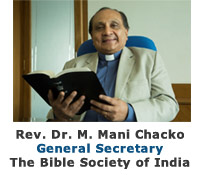
Rev. Dr. M. Mani Chacko
General Secretary
The Bible Society of India