We have tremendously high expectations of Christmas. We want everything to be perfect. We have pictures in our minds of children playing, church choirs singing, and people smiling and getting along. But often it is not that way. It is supposed to be, as the song says, “the most wonderful time of the year” and the “hap-happiest season of all.” But for many it will be a very difficult time because something has interrupted the joy. It may be COVID 19, sickness, or death, or divorce, or loneliness.
The Bible Society of India Andhra Pradesh Auxiliary in collaboration with The Book Room, Bangalore has organized a National Bible Fair from 19-21 November, 2021 at CSI St. Paul’s Basilica in Vijayawada. The BSI National Vice-President & AP Auxiliary Treasurer Dr. Mrs. P. Leela Bose inaugurated the Bible Fair in the presence of Mr. Paul Stephen, Director-Publishing & Marketing, Bro. M. Johnson, AP Auxiliary Vice-President, Rev. K. John Vikram, AP Auxiliary Secretary, and local branch leaders and pastors. The Scriptures of various categories were exhibited and sold to the public. The local churches and book sellers have made ample use of this opportunity.
RANCHI AUXILIARY
Annual Bible Exhibition cum sale: The Annual Bible Exhibition and Sale of BSI Ranchi Auxiliary was held on 22nd – 30th November in Bible house, Ranchi. Even in the midst of this pandemic situation, many people visited this event with great excitement as the discount was the main attraction of this sale. Along with the bulk order ,people purchased different kinds of Bibles for their own family members, relatives and friends. On the last day, it was so encouraging to see a family, purchasing three different Bibles for its three members. In this way, we see God’s hand in helping Bible society to reach out with the Word of God to people groups of different languages and different age groups. Praise be to our God
TAMIL NADU AUXILIARY
The Bible Society of India, Tamilnadu Auxiliary & The Book Room joined together in conducting the National Bible Fair – 2021 at the Madras Memorial Hall, Chennai, from 26th to 28th November 2021 ( Friday to Sunday) .The inauguration and the new Bible release took place on 25th November 2021. Rev John Giridharan of Madras Diocese presided over the inaugural function and explained about the importance of the Word of God. Mr. Paul Stephen Director- Publishing & Marketing gave a brief explanation about the Bible Exhibition as well as new publications. Rev.P.Moses Devadason the Sr. Auxiliary Secretary, Tamilnadu extended his greetings and welcomed the Pastors, supporters and the gathering. All three days there was intermittent rain causing water logging in many parts of Chennai. To our great surprise the Lord brought many people inspite of the adverse weather conditions. God’s grace was beyond our expectation and we were able to cross rupees one crore mark in our sale. Once again we praise God for his grace and mercy.
Rev. Dr. M. Mani Chacko General Secretary, Bible Society of India
We have tremendously high expectations of Christmas. We want everything to be perfect. We have pictures in our minds of children playing, church choirs singing, and people smiling and getting along. But often it is not that way. It is supposed to be, as the song says, “the most wonderful time of the year” and the “hap-happiest season of all.” But for many it will be a very difficult time because something has interrupted the joy. It may be COVID 19, sickness, or death, or divorce, or loneliness.
We look to the Christmas season to be a time of perfect peace, harmony, and joy. But the first Christmas was not that way. It was an interruption.
Interruptions can happen at any good time. Consider the timing of Joseph and Mary’s interruption. They were engaged to be married. Like Christmas, an engagement is supposed to be a wondrous time. But it was during this time that an angel appeared to Mary and told her that she would miraculously, as a virgin, conceive and give birth to the Son of God. What joyful news! Yet, what an interruption! How would she explain her pregnancy to Joseph? Would he believe her? Would he be willing to take on that responsibility? This was not in their plans. And yet, she accepted it.
We know how Joseph responded. He didn’t believe her. How could he? His plans for a happy home with the woman he loved were dashed before his eyes. His life, as well as hers, had been powerfully interrupted.
If we are not careful, our response to an interruption can send us down the wrong path. Joseph nearly went down the wrong path. When he discovered Mary’s pregnancy, he was devastated. He couldn’t buy her story about a virgin conception. As much as he loved her and wanted to be with her, there was nothing to do but divorce her.
A betrothal – an ancient engagement – was much more binding than today’s engagements. The only way out of one was divorce. In fact, Joseph had the right to have her stoned to death for infidelity. Yet because he was a good man, he did not want to harm her or even embarrass her. He would divorce her privately. This was Joseph’s human response to a powerful interruption. But what a mistake it would have been.
Often an interruption brings on a knee-jerk reaction. We make decisions that, if we were better informed, we would not make. We must be careful that when we face an interruption, we don’t just react according to our own fears and feelings.
The key to handling an interruption is to get God’s take on it. Thankfully, God rescued Joseph from his error. I can imagine Joseph, having learned of Mary’s situation, tossing and turning in bed, trying to decide what to do. Finally, he decides. He will divorce her privately. But while he is sleeping an angel of the Lord appears to him in a dream and says,
“Joseph, don’t be afraid to take Mary as your wife. What she says is true. The child in her womb is from the Holy Spirit. She will give birth to a son and you are to give him the name Jesus because he will save his people from their sins. This is in fulfillment of what God said through Isaiah the prophet, ‘The virgin shall conceive and give birth to a son, and He shall be called Immanuel meaning ‘God with us.'”
Joseph awoke with a changed mind. He would not divorce Mary. He would take her as his wife and help raise this miraculous child. He had gotten God’s perspective of his interruption.
When you encounter an interruption, whatever it may be, don’t react according to your own feelings and thoughts. Seek God’s direction. Remember Proverbs 3:5-6: “Trust in the LORD with all your heart, and do not rely on your own understanding; think about Him in all your ways, and He will guide you on the right paths” (HCSB).
Here are three words to remember when you encounter an interruption.
Prayer
The first thing to do when your life is interrupted is to stop and pray. Pray for guidance. Pray for courage. Pray for help. When you look to God He will help you.
Perspective
Put the interruption in the proper perspective. How bad is it really? How long will it actually be important?
Providence
Keep in mind that God, in God’s providence, is still in control of your life. Nothing can happen to you without the leave and notice of your Father. He still has all of the hairs on your head numbered.
Interruptions can at times positively redirect our lives. This was true of Joseph and Mary. Their plans were interrupted, but oh what an interruption. Can you imagine a more wonderful privilege, or a more challenging responsibility, than to be the human parents of the Son of God? The direction their future took was not what they had planned, but it was so much better.
Have you ever considered that God could do that kind of thing in your life? Not that you would be made the parents of the Son of God, but that God would take what seems to be an interruption, an unforeseen problem, and use it to set your life on a new and better path.
Whatever interruption you may be enduring right now, why not look at it in a different light, and ask, “God, are you using this to do something great in my life?” Then begin to look for the marvelous things He will do.
Whatever interruption you may be experiencing this Christmas, there is one thing you can do: stop and give thanks to God for Jesus. And as you praise and thank God, even in the midst of difficult circumstances, something of the peace that Jesus came to bring will be yours.
It was a wonderful time of sharing the Word of God and the ministry of BSI with the people of Serango Satabdi Church, Serango, Gajapati Dist.
I thank God for His protection and extend my thanks to all of you for your prayers. In this time of difficulties, I could travel more than 350 km which took me about 12 hours by bus.
This Village called Serango is a hill area so no direct train or bus is available, still I could preach the good news. This would pave the way in building relationships with the churches, through which we have received another invitation in the month of May for the distribution of Bibles and collection for BSI.
This is one of the big congregations in the Gajapati District. In spite of the Covid restrictions though everyone could not participate in the service, I had taken the opportunity of ministering to them by sharing the Word of God and the ministry of BSI. After the service, we had a meaningful discussion with the Church leaders and youth leaders in which they were encouraged to pray and support the BSI ministries. Thanks for your prayers.
RANCHI AUXILIARY
Reported by Rev Soma Bhatkar
Bible Sunday on November 21, 2021 at Bandorjuri Village, Dumka District, Jharkhand State. This tribal community are laborers working in the farmland, but have a heart of giving. They are our ardent supporters in the ministry of the Bible Society of India through their prayers and donations.
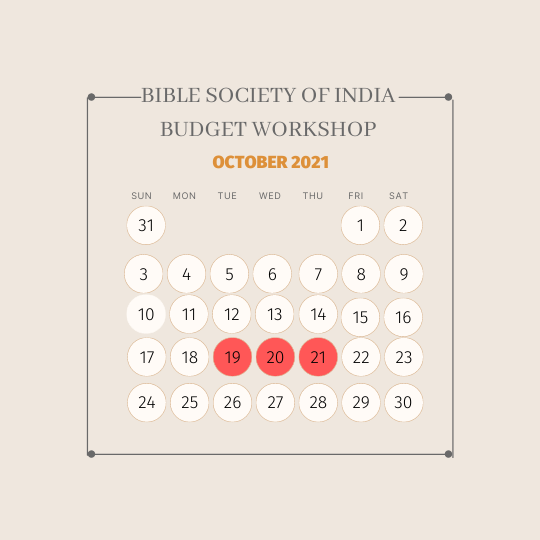
We are hereby intimating you that the CO Budget Workshop for the year 2021 is scheduled for 19th, 20th and 21st October 2021 (Tuesday, Wednesday and Thursday). It will be a physical Budget meeting
Venue :William Carey Centre, No.16, Hall Road, Richard‘s Town, Bangalore–560005
Rev. Dr. M. Mani Chacko General Secretary The Bible Society of India
In the recent past, we had to confront deaths of several of our loved ones, including nine of our own dear colleagues succumbing to the Covid Pandemic. All of them could be, without any shadow of doubt described as “persons who have lived a life of kenosis”, emptying their own lives for the development of the other. The departure of the above loved ones made me to ponder over the importance of developing and practicing a Theology of Death by the Church at large so that people do not become afraid of death but instead face death boldly viewing death as a natural and normal process of life. For this, Job 1:21 is taken as a tool from which a few pertinent observations are culled out to develop a Theology of Death. Job is regarded as a blameless and righteous person, who shunned away from all evil. Yet he had to undergo suffering including the death of his children. When the news reached Job about the death of all his children, he got up, tore his robe, shaved his head and fell to the ground in worship and remarked “Naked I came from my mother’s womb, and naked I will depart. The LORD gave and the LORD has taken away; may the name of the LORD be praised” (1:21).This statement of Job is moving and thought provoking. It projects three elements which can help us in developing a Theology of Death.
Firstly, the Nothingness of Life.
Job’s statement “Naked I came…naked I will depart” points to the fact that Job understood the ordinariness and the impermanence of life. He realized human life is fragile and that he is nothing. In the Biblical account of Creation in Genesis 2:7, it is stated that God formed the human out of the dust of the ground. So the human according to the Biblical writer is nothing but dust. Dust and ashes in Hebrew thought stand for nothingness and ordinariness. This thought is beautifully expressed further in Isaiah 40:6-7 where it reads “All people are grass; their constancy is like the flower of the field. The grass withers, the flower fades… Surely, the people are grass”. Uncertainty of life and certainty of death are emphasized here. Job knew well that if one is born, he/she is to die. Life and death are part of a natural process. Hence Job was able to affirm “Naked I came…naked I will depart”.
Secondly, the Sanctity of Life.
Job continues his theological utterance by stating “The LORD gave and the LORD has taken away”. Here Job acknowledges that the life is God’s. God is the source of life and hence God is its owner. If God is the owner of life, God the owner can take away life as per God’s will. When God the owner of life takes life away, we have no right to question God, the owner and fall into skepticism. Rather we need to thank God for the life given and lived till death. A primary element in a Theology of Death is God’s ownership of Life. In Genesis 2:7, it is written that after forming the human out of the dust of the ground God breathed into his nostrils the breath of life. The Biblical account reiterates the fact that God is the source of life and that God gives life as a precious gift to the human to live and to experience the joy of living. Because life is God’s, life is sacred. There is sanctity in life. The human needs to realize this aspect and receive this gift of life with a sense of gratitude and be responsible in living the life which God has given. Life is not to be wasted away. Rather it is to be lived in all its fullness. Job realized this great truth and therefore in the midst of bereavement he was able to say “The LORD gave and the LORD has taken away”.
Thirdly, the Approach to Life.
Job’s last statement “let the name of the LORD be praised” is equally significant. It is also to be noted that Job tore his garment, shaved his head and worshipped God and uttered the above statement. These are amazing words and the wonder of it grows when we realize the context in which these words were spoken- loss of everything including all his 10 children! His approach to life during the moments of crisis was not one of dejection but one of creative outlook. He did not question God by asking “Why?” Rather out of great humility he worshipped God by saying “Let the name of the LORD be praised”.
Creative approach was the way Job encountered suffering and death. Dr .Paul Tournier in his book “Creative Suffering” writes about 330 world leaders like Hitler, Napoleon, Lenin, Alexander the Great who all came up in life as orphans. They all faced Life and its challenges with a creative outlook. Religions have put forward different views on Suffering in life. In Hinduism, there is the doctrine of Karma that suffering is because of one’s actions. Good intent and good deed contribute to good karma and future happiness, while bad intent and bad deed contribute to bad karma and future suffering. There is the doctrine of Kismet in Islam that suffering is the will of Allah. In Zoroastrianism, there is the teaching that evil/ suffering is caused in life by Ahriman, the God of Evil and good and prosperity by Ormazd, the God of Goodness. Buddhism advocates the view that suffering in life is due to one’s Attachment to worldly desires and the way out of suffering is to detach oneself from the world by following the Eightfold path. In Christianity, the way to face suffering is by the way we approach suffering by making suffering creative. Paul and Jesus are the best examples of Creative Suffering. Paul says, “… I have learned to be content whatever the circumstances. I know what it is to be in need, and I know what it is to have plenty. I have learned the secret of being content in any and every situation, whether well fed or hungry, whether living in plenty or in want. I can do everything through him who gives me strength” (Philippians 4:11-13). Jesus in the midst of agony and pain cried out “Father, into your hands I commit my spirit” (Luke 23:46). Both Paul and Jesus approached suffering with a creative outlook.
CONCLUSION
Death is a somber subject indeed. None wants to face it. We take all precautions to escape death like medication, exercise etc. Yet the reality is, it comes irrespective of caste, color, creed, gender or age. None can escape death. The best option humans have is to realize that Life is nothing; Life is to be received as a gift from God to be lived responsibly and Life and its challenges including death have to be faced creatively with a spirit of optimism. By developing such a Theology of Death, life continues on the planet earth in all its fullness. Death ceases to be a threat to be afraid of. Rather Death becomes a part of the process of living.
The Bible Society of India had the privilege to observe the “International Literacy Day” throughout our offices in India.
Imagine how different our life would be if we had never learned to read or write or understand any writing. For millions of people in the developing world, this is the reality. The lack of education significantly impacts their ability to step out of poverty. Literacy unlocks human potential and is the cornerstone of development. It leads to better health, better employment opportunities, safer and more stable societies.
The Bible Society of India observed the International Literacy Day on September 8, 2021. We are committed to pray especially for children that they may gain wisdom, and discernment through education to experience the fullness of life God intends for each of them.
World wide, an estimated 250 million children, adolescents and youth weren’t in school and more than 100 million youth are not learned (Global Education Monitoring Report 2020). Despite progress over the recent decades, many children in school do not achieve functional literacy and numeracy skills due to overcrowded classes, lack of supplies of books and materials, unskilled teachers, who need more training, or disruption due to disasters and prolonged crisis like the Corona virus pandemic as in the pass two years.
The choice to intentionally engage in literacy activities is integral to the Bible Society’s mission. The ability to read the Bible for oneself, find meaning from it, and digest it as God’s message for one’s life, family, community, and society is a vital resource the value of which cannot be overstated.
Literacy is a prerequisite to the majority of current Bible translation and engagement programmes, which aim for transformation at the personal, familial, and societal levels.
Although an audio or visual experience may be the initial way a non-literate person experiences the Bible, the ultimate goal of Bible engagement is to be able to navigate through the Bible oneself.
Concerns for intercession were:
Pray for an end to the generational cycle of illiteracy and poverty.
Pray for parents to support their children’s education.
Pray for children’s safety at school.
Pray for protection of children who aren’t attending school.
Pray for girls growing up in cultures that do not value their education.
The United Nations General Assembly had declared 21st September as International Day of Peace. It is observed to be a day of global ceasefire and non-violence. Currently, we see political turmoil, violence and war in Afghanistan and between Israel and Palestine and conflicts in different parts of the world. The Bible Society of India came together as a community of Bible workers to pray for International Peace and to seek God to restore peace on this earth.
Our three North Eastern Auxiliaries namely, Aizawl, Dimapur and Shillong prepared the order of service for the day. We sought God for his forgiveness for all humankind as we have not always acted for peace. We ignore God’s calling to be peacemakers to our neighbours, communities, states and nations. We as a community might have caused divisions among ourselves and to people around us. We sought God to make us a channel of peace to others.
Intercessory prayer was offered for the peace in Israel and Palestine, where violence and war continue to injure, kill innocent people and destroy properties. We asked God to take control of the situation and speak to the leaders of Israel, Hamas and Palestinian so that they come to negotiation table to resolve differences and restore peace in their land.
We also offered prayer for peace in Afghanistan as the Afghans are living under threat; especially the women are curtailed from their freedom of movement and education under the new Taliban rule. We pray that the Lord would grant the political leaders to rule their country with justice and equality, and peace may be restored in their land.
Language is a means of communication. The International Translation Day is a special day in the history of translation of the Bibles. It is a day to pay our tribute to the translation work done by our language professionals, and the translators. The task of translation plays an important role in bringing nations together, facilitating dialogue, understanding and cooperation, contributing to development and strengthening world peace and security. On 24th May 2017, the resolution approved by the General Assembly of the United Nations was to commemorate the role of language professionals and the translators. Thus, the United Nations declared 30th September as the International Translation Day.
Generally, on 30th September the United Nations celebrates the feast of St. Jerome, one of the pioneers of the Bible translators, who is considered the patron saint of translators. St. Jerome was a priest from North-eastern Italy, who is known mostly for his endeavor of translating most of the Bible into Latin from the Greek manuscripts of the New Testament. He also translated parts of the Hebrew Gospel into Greek. Jerome died near Bethlehem on 30th September AD 420. Thus, to remember this great saint Jerome and his contributions towards the translations, we, the members of the Bible Society of India are gathered together to celebrate this special day dedicating our present language professionals and the team of translator into God’s hand for the extension of God’s reign.
The Bible Society of India in all its offices observed the International Translation Day during our morning prayer. A special order of service prepared by the BSI Translations Department was followed.
We had video presentations on the following topics:
Bible for everyone
Bible translation in Braille Script
Jesus and the deaf man from Mark 7:31-37 (Sign language)
Greetings from the United Nations officials
Please continue to pray for:
Sustenance and wisdom for all Bible Translators
Protection over their family members
More Bible Translators to be trained and raised up
The Bible Society of India joins the deaf community around the world in celebrating the International Sign Language Day representing more than 70 million people on October 4th, 2021.
The theme for this year is “We Sign for Human Rights.” It is a celebration and voicing with collective efforts of the deaf communities. Civil society agencies and organizations, Churches and governments to recognize the sign languages as the heart language of the deaf and to promote the sign languages.
The deaf children from Deaf Biblical Ministry, Dimapur, Nagaland brought greetings, offered a special song and read the Bible portion from St. Mark 7:31-37 in sign language.
Rev. Dr. Along Jamir, Associate Director, BSI Translations gave reflection on this special day.
What is Sign Language?
Sign language is not just a tool for communication. It is a natural language and it has its own components such as shapes, facial expression, location, movement and orientation. Language always comes from the heart, to express feelings, imagination and ideas.
They hear with their eyes!
They speak with their hands!
Sign languages exhibit the same linguistic universals and written/spoken languages. The phonemes, morphemes, and syntax can be analysed in sign languages, as genre, function, sequence, narration and meta narration too.
It is their identity, consciously assumed it is life! Each deaf community in every country of the world speak a different sign language.
Deaf Culture and Sign Language
Their identity as deaf, deafness, deafhood is what defines their culture, their culture is a way of feeling and seeing the World from a minority culture and language that is oppressed by the dominant language and culture of the hearing. They are people lost in the midst of a world of hearing, such identities that deserve to be taken into account by the hearing community, not through pity but giving due respect and upholding their values, cultures and language.
Just deaf (Never deaf and Dumb)
Sign Language is not universal
They have proper grammar
Intercessory prayer was offered for the deaf community as this is the largest unreached people group to acquire the Bible in their language. Please join us in praying for the deaf community in our country and continue to journey with us, as Bible Societies across the continents take new initiatives to bring God’s Word in sign languages.