Blog

GOD IN THE MARKET PLACE

The term ‘marketplace’ is used to mean ‘the public square’ in the widest sense. That is, I am not thinking only of ‘the market’ in a purely economic sense, but the whole world of work – trade, professions, law, government, education, industry – wherever human beings engage together in productive projects. The Old Testament word was ‘the gate’ – the public square where people met and did their business together, of whatever kind.

Is God interested in the marketplace? Many Christians seem to operate on the everyday assumption that He is not. Or at least, that God is not interested in the marketplace for its own sake, as distinct from interested in it as a context for evangelism. God, it would seem, cares about the Church and its affairs, about getting people to heaven, not about how society and its public places are conducted on earth. The result can be a rather dichotomized Christian life in which we have to invest most of the time that matters (our working lives) in a place and a task that we think does not matter to God, while struggling to find opportunities to give some left-over time to the only thing we think does matter to God—evangelism. Yet the Bible clearly and comprehensively, in both Testaments, portrays God as intensely interested in the human market place—interested, involved, and in charge.

Work is God’s idea. Genesis chapters 1 and 2 give us our first picture of the Biblical God as a worker – thinking, choosing, planning, executing, evaluating. So when God decided to create humankind in the image and likeness of God, what else could humans be but workers, reflecting in their working lives something of the nature of God? Specifically, God laid upon human beings the task of ruling the earth (Genesis 1), and of serving and keeping it (Genesis 2). This enormous task required not only the complementarity of our male-female gender identities, for mutual help, but also implies some other fundamental economic and eco-logical dimensions to human life.

God has given us a plan with vast diversity of resources scattered all over its surface. There is, therefore, a natural necessity for trade and exchange between groups living in different places, to meet common needs. That task in turn necessitates economic relationships, and so there is the need for fairness and justice through-out the social and economic realms. There needs to be justice both in the sharing of the raw resources with which we work, and in the distribution of the products of our work. The biblical witness is that all of this great human endeavor is part of God’s intention for human life on earth. Work itself is of the essence of our human nature. We were created to be workers, like God, the Worker.

According to the Bible, God is the independent judge of all that goes on in the marketplace. The Old Testament speaks repeatedly of Yahweh as the God who sees and knows and evaluates. This is true in the most universal sense, and of every individual (Psalm 33:13-15).

But it is specifically true of the public square. Israel was reminded repeatedly that God calls for justice ‘in the gate’, which is in contemporary terms, the marketplace (Amos 5:12-15). Further-more, God hears the kind of talk that would go on either in the hidden places of the greedy heart, or in the confidence of a business deal. Such exploitative talk is condemned by the prophet (Amos 8:4-7). And for those who think that God is confined to his temple and sees only what goes on in religious observance, comes the shock that he has been watching what goes on the rest of the week in public (Jer. 7:9-11).

A common Christian assumption is that all that happens here on earth is nothing more than temporary and transient. Life here is nothing more than the vestibule for eternity, so it doesn’t really matter very much. To this negative comparison is added the idea, drawn from a mistaken interpretation of the language of 2 Peter 2, that we are headed for total obliteration of the whole earth and indeed of all the physical creation. With such a prospect, what eternal value can possibly attach to the work we do in the world’s marketplace here and now?

But the Bible presents a very different prospect. God plans to redeem all that He has made, and included within that will be the redemption of all that we have made with what God first made. Isaiah 65:17-25 is a glorious portrayal of the new creation – a new heaven and a new earth. It looks forward to human life that is no longer subject to weariness and decay; in which there will be fulfilment in family and work; in which the curses of frustration and injustice will be gone for ever; in which there will be close and joyful fellowship with God; and in which there will be environmental harmony and safety. The whole of human life, private, family and public, will be redeemed and restored to God-glorifying productiveness.

All human history, then, which takes place in the marketplace of human public interaction, will be redeemed and fulfilled in the new creation – not just abandoned or destroyed. All human work, then, in that marketplace, has its own value and eternal significance, not just because of our understanding of creation and the mandate it laid upon us, but also because of the new creation and the eschatological hope it sets before us. With such a hope, we can heartily follow Paul’s exhortation, knowing that ‘the work of the Lord’ does not mean just ‘religious’ work, but any work done for as unto the Lord, which includes even the manual labour of slaves: Always give yourselves fully to the work of the Lord, because you know that your labour in the Lord is not in vain (1 Cor. 15:58).

The twin sayings of Jesus about being salt and light in the world (Mt. 5:13-16) are still crucial insights into what it means to follow Jesus in the Market Place. Jesus applies these metaphors explicitly to practical living, not merely religious devotion or evangelistic witness. As a Bible Society, along with Translation, Production and Distribution of Scripture, Scripture Engagement is an important area we work on. Realising that God is in the Market Place and of the Market Place, Bible Society of India engages herself in relating the Word to the World by identifying with the suffering humanity and also by encouraging the readers of the Bible to be good stewards of God’s Creation by caring for the environment and by being just and ethically upright in the Market Place in our different spheres of work, depicting clearly and convincingly that God is in the Market Place .


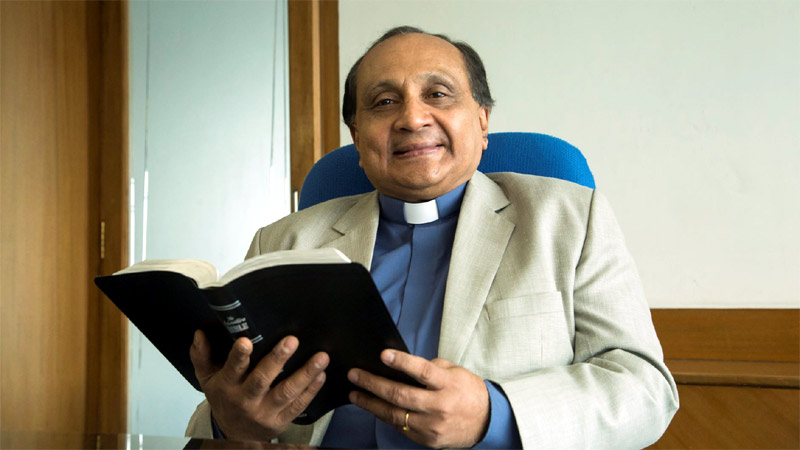
Rev. Dr. M. Mani Chacko
General Secretary
Bible Society of India

Read more

Tribal And Adivasi Day

By following the UN Indigenous Day, i.e. August 9, on 17 September 2010, during the Annual General Body Meeting of National Council of Churches in India in Bangalore, for the first time announced observance of the NCCI-Tribal and Adivasi Sunday. NCCI, therefore, urges and requests constituent members to annually observe every Sunday closest to 9 August as NCCI Tribal and Adivasi Sunday and the date to be marked in the Church calendar and diary.

During this COVID-19 pandemic across the globe in order to have a better understanding of the life situation of the Tribal and Adivasi communities in India and to have a common form of worship for this special day, the Bible Society of India as member of the National Council of Churches in India also celebrated the NCCI TRIBAL & ADIVASI DAY under the Theme “COVID19 AND RECLAIMING OUR INDIGENOUS HERITAGE” on 7th August 2020 Friday in all its offices spread across the nation. Covid-19 has exposed our vulnerability and inadequacies. The vulnerability of humans is that: richness, power, authority none could save a person from being infected by the virus.

In India’s Tribal and Adivasi areas, basic health care facilities are extremely poor. Besides, a lack of key information and awareness to effectively deal with outbreaks further add fuel to the fire. During this pandemic the Tribal and Adivasi became more vulnerable because they lack access to effective monitoring and early warning systems. Lives of an Adivasi and Tribal will not be the same post Covid-19 pandemic. Challenges await, lurking behind the idea of segregation, unemployment, health and hygiene, education and so on.

The nationwide lock-down has affected the economy of India’s Tribal and Adivasi communities living in and around the forests of India, as they depend highly on the forests for food, shelter, medicines and financial income. While the tradition and cultures of the Adivasi and Tribal people consider nature as the very centre of all existence, today in the name of development they are deprived of their inheritance and displaced from their native places, and sole natural resources of their livelihood are exploited and taken away from them.

They have been denied inherent rights and dignity by a mainstream society that refuses to hear their pleas. The current lock-down situation aggravates their inability to influence government workers and protest against the exploiters making them less visible and more vulnerable. However the cultural heritage of communiterian life becomes a great source of their strength in their fight against Covid-19. In spite of poor healthcare facilities – care, love and concern for each other become the great source of strength that comfort and prevent the community from major disaster with a minimum death tolls compared to the National records.

ROLE OF BSI AND THE CHRISTIAN COMMUNITY:

In such uncertain times, societal upheaval, the threat of poverty, sickness, and death all these naturally led to fear. In situations like these one of the best things we can do is remember just how great, strong and mighty, faithful, and compassionate our God truly is. Corona must have affected many, yet in the midst of such troubles let our fortitude, faith, and hope in God’s unwavering assurance give us the encouragement to find a cause of glorifying God. The liberating message is that struggles and difficulties are part of our life in the present situation with Covid-19, with many challenging news reports around us.

What The Bible Society of India, the Christian Community, and the Church can do is to become innovative by initiating recovery programs, emphasi ze sustainability, and engage with the people affected by the Covid-19 Pandemic and serve as a beacon of hope and compassion for the world.

Read more

OBSERVANCE OF NATIONAL DAY OF PRAYER

The Bible Society of India joined the National Council of Churches in India (NCCI) and Evangelical Fellowship of India (EFI) by observing National Day of Prayer across India to earnestly intercede for our country, our leaders and our fellow citizens. The National Day of Prayer is an ecumenical movement, freely owned by all, and it is a call to unity for strengthening our Christian witness and service for the World. The Bible Society of India had a very meaningful worship in the Central Office in Bangalore as well as in all our Auxiliary offices across India on August 14, 2020, at 9 am.

Read more

2008 Kandhamal violence

The 2008 Kandhamal violence refers to violence between groups led by the Sangh Parivar, and Christians in the Kandhamal district of Orissa, India, in August 2008 after the murder of the Hindu monk Lakshmanananda Saraswati.

Tensions reportedly started with violent incidents over Christmas 2007 which resulted in the burning of over 100 Churches and Church institutions, including hostels, convents, and over 700 houses. Three persons were also killed during the three days after Christmas. The Hindutva groups and activists of the Kui Samaj were mostly involved in the 2007 attacks.

The intensity of violence began after the murder of the Vishwa Hindu Parishad (VHP) leader Lakshmanananda Saraswati on 23 August by Maoists. According to the government reports the violence resulted in at least 39 people killed, all Christians. More than 395 Churches were vandalized or burnt down, over 5,600 houses plundered or burnt down, over 600 villages ransacked and more than 54,000 people left homeless. Reports put the death toll at nearly 100 and suggested more than 40 women were sexually assaulted. Many Christians were forced to convert to Hinduism under threat of violence This violence was led by the Bajrang Dal, Rashtriya Swayamsevak Sangh and the VHP.

As we commemorate the 12th anniversary of the Kandhamal Day, we remember the dreaded series of violence that took place and the death of many Christians from the Tribal and Dalit communities. The politicization of faith, community, economic and the nation’s cold responses were some of the reasons why we commemorate the Kandhamal Day with pain. This is to say, this kind of instigated violence and hatred that had caused many innocent lives should never happen again in our society. In the midst of pain, we are thankful to all those who are working for the reconciliation and re-establishment of communities in Kandhamal, Phulbani district of Odhisa. May God continue to look upon and heal those who are yet to recover from this traumatic violence.

Read more

FOR THE FIRST TIME IN HISTORY, A FULL BIBLE HAS BEEN TRANSLATED INTO 700 LANGUAGES GLOBALLY

In August 2020, the number of languages with full Bible translations hit 700 for the first tim e. We celebrate that more than 5.7 billion people—or around 80 percent of the global population—now have the full Bible in thei r heart language. At this milestone moment, we thank God for the promise He makes in Isaiah 55:11—”that as His Word goes forth, it will accomplish His purposes.”

Source: American Bible Society

BUY BIBLES ONLINE

Read more

REV. Dr. M. Mani

THE GREAT COMMISSION TEXT AND THE MISSION OF GOD IN THE NEW NORMAL

The Great Commission Text in Matthew 28: 18-20 is the key text for our engagement in the Mission of God. The Church around the globe and the various mission bodies had been caught up with the mandate for mission inherent in this text. Our nation is no exception when it comes to the presence of missionaries spreading the Gospel of Jesus Christ. The text has become a foundational text for aggressive missiology underlying new evangelical movements in the sects and main-line Churches. The text has been used and abused over the years and hence a flawed understanding of mission was developed forgetting or ignoring other important dimensions of mission. In the New Normal and beyond the New Normal what we are experiencing today, how we understand the Great Commission Text and the Mission of God is of utmost importance.

1. The Great Commission Text
The text concludes the Gospel of Matthew, which is regarded as the most meticulously constructed writings of the New Testament. It is a worthy finale to the Gospel. As scholars have pointed out, it is a summary of the whole Gospel by weaving together its Christological (Mt.28:18), Ecclesiological (Mt.28:19-20a) and Eschatological (Mt. 28:20b) threads into a carefully crafted composition, whose theological density rivals that of the prologue of John.

There are two parts in the text: an introductory narrative featuring eleven disciples (vs. 16-17) and a solemn announcement of Jesus (vs. 18-20). It is often argued that the event is a post-resurrection appearance of Jesus. There is nothing in the Gospel of Matthew to suggest that it was the risen Lord who had appeared to the disciples. All the elaborate process of the verification of the reality of the body of the risen Lord, which is profoundly explained in Luke and John, is missing in Matthew. Here the focus of the story is not on appearance of the risen Jesus, but on the message he gives. The message takes the form of a three-step proclamation – a revelatory statement (vs.18), a mission command (vs.19-20a) and the promise of the divine presence (vs.20b).

There were attempts made to identify the literary form of the text. It has been variously compared, (1) to an Ancient West Asian enthronement ritual, which contained three successive actions, (2) to a type of `divine pronouncement’ comprising of three elements as found in several Old Testament texts like Exo 20 or Deut 5, (3) to the form used in Old Testament stories of the commissioning of charismatic leaders like Moses in Exo 3:4-12, (4) to an `official decree’ like that of Cyrus in 2 Chron 36:23, (5) to the `covenant formula’ derived from the Hittite suzerain treaties and widely used in the Old Testament covenant texts, (6) and to the “I am sayings of Jesus”. Although the above models are possibilities that may have influenced the writer of the Gospel of Matthew, it is very unlikely that he was following a precise literary model in the Great Commission text. The text could be seen as a natural expression of a commissioning through a transcultural functional `genre’, which can generate similar texts in different contexts. It is, therefore not necessary to locate the text in a particular Jewish or Hellenistic setting or model.

Coming back to the three elements that shape the text, it is clearly the mission command (vs. 19-20a), which is central. Both the revelatory statement (vs.18) that precedes and the promise (vs.20b) which follows it, reinforce the command. The command has four verbs. Of the four verbs three (going, baptizing, teaching) are qualifying participles. Only one, “making disciples of” of “disciple” is a finite verb, and contains the main imperative of the command. For Matthew, to engage in mission is to strive to make “all peoples” disciples of the risen Lord. The universal mission to make disciples is to be achieved by baptizing them and by teaching them to observe what Jesus had commanded. It is a portrayal of the emergence of a new community that is emerging through a new rite of initiation, which replaces circumcision and through a new kind of teaching, the core value of which is love (Mt. 22:40). The accent here is not on the “going out” but on “teaching” and thereby “making disciples.” Baptism is to be seen only as an outward symbol of the inward transformation that is taking place. To treat the text primarily as a commission text mandating Christians to a universal mission is outside the scope of Matthew. The tendency to make the text as the Great Commission text is a later development of the colonizing mentality that was prevalent in history. The basic thrust of Matthew is to build an alternate community based on the teaching of Jesus and the focus is not on the “going out” or “baptizing.”

2) Interpreting the Great Commission Text and the Mission of God
The Great Commission text had been taken out of its context and read as an autonomous decree. The text, which is an editorial masterpiece, is now read as a simple `Great Commission’. The text is a worthy finale to the Gospel of Matthew and if so, it should be read as a part of the entire Gospel and not in isolation from other equally important texts. Such a reading of the text is dangerous and can lead us to a damaging missiology. Mission is no longer seen as the spontaneous and joyous communication of the experience of the risen Lord. Rather it is now seen as a `duty’ imposed on people. Mission fueled by triumphalistic statements degenerates into a `conquest’ where the numerical expansion of the Church or political or economic advancement of its leaders become the goal. Mission ceases to be an act of service and becomes a selfish exercise of survival, expansion and power. A corrective to this understanding of mission can happen provided we engage in Biblical interpretation with utmost seriousness keeping in mind it is the God of the Bible and not the Bible itself that we need to focus on in our reading and interpretation of the Bible. The following two hermeneutical methods or principles would be of help in such an attempt.

a) Integrated Reading
The Great Commission text needs to be read along with other texts such as the Mission Discourse in Matthew 10: 1-42, and the largely neglected mission command found in Matthew 5:13-16. The first text talks about Jesus’ mission instructions to his disciples as to how they should conduct themselves when they engage in God’s mission. Those involved in mission are called to a life of missionary discipleship and not just a commissioning to missionary activity. Such a life calls for a radical detachment from possessions and family ties, a radical trust in God and a radical fidelity to Jesus in all conflicts and persecutions that they would encounter. Mission, as Matthew understands it, is not a `command’ by means of which Christians are forced into some reluctant activity. It is not an enterprise that depends on human resources. But rather, it is carried out in poverty and powerlessness that depends on God alone. The `Great Commission’ text when read with the Mission Discourse in Matthew 10 challenges us to engage in God’s mission in a spirit of poverty and powerlessness.

The other text of significance is Matthew 5:13-16. This text gives us an understanding of mission which complements that offered by the Great Commission. In it, mission is described in terms of being or witnessing than verbal proclamation. This dimension of `being’ or `witnessing’ strives not for `Church growth’ but for the wholeness of creation. There is also a communitarian dimension inherent in this text, which is often overlooked. The mission command in 5:13-16 is not addressed to individual followers of Jesus but to the Christian community as a whole. It is this community that is supposed to be the salt of the earth and the light of the world. Any verbal proclamation to be authentic must be lived out in the Christian life of the community. This text also underlines yet another forgotten or ignored dimension of mission. It powerfully advocates the view that the mission command is not Ecclesio-centric nor Christo-centric but Theo-centric.

The ultimate aim of mission is to lead people to give glory to God and this happens when we contribute to the establishment of the Reign of God on earth. The aim of mission here is not so much planting the Church, nor conquering the world for Christ nor fostering Church growth, as leading history to its fulfillment in the full realization of the Kingdom of God. This understanding of mission is relevant to our context today. Our missiology should be centered on God rather than on the Church or even Christ. Such a theo-centric focus is nothing to be embarrassed about, for it is very much biblical. The biblical story begins and ends not with the Church nor even with Christ but with God who is all in all. Thus this mission command offers a double corrective to the flawed understanding of mission. Firstly, it extends the aim of mission from a narrowly Ecclesio-centric or Christo-centric to a fully Theo-centric one and that is building up of the Reign of God on earth. Secondly, it shifts the emphasis of missionary praxis from individual proclamation to prophetic community witness.

The integrated reading of the biblical texts helps us to understand mission in a holistic manner bringing to light different dimensions of the text, which otherwise would have been hidden from us. The realization of such mission perspectives helps us to have a balanced understanding of God and God’s mission. This in turn helps us to look at our neighbour not as an object of evangelization but as a fellow human created in God’s image. This outlook of life will enable all of us despite our varied faith affiliations to work together in making the world a better place to live in.

b. Perspectival Reading
Another method we can employ in the reading of the Bible is to read the texts with a perspective. The perspective I adopt in my readings is the perspective of life. The central message of the Bible and of Christ, I believe is life in all its fullness and abundance. It is from this perspective I engage in biblical interpretation. When we view the Great Commission text from this perspective of life, it is to be noted that the Great Commission is given in the context of another military expansion that was happening, i.e., the expansion of the Roman Empire. Jesus’ commissioning of his disciples to a worldwide mission was taking place in the context of another worldwide mission that was already operative, the mission of the Roman Empire. That was the time when the Roman empire was engaged in a ruthless mission to dominate the entire world and bring the world under its authority and dominion. Anyone who challenged or posed a threat to the Roman rule was eliminated mostly by crucifixion. When Jesus was born and Herod came to know that the “King of Israel,” a possible threat to the Roman authority was born, he wanted to eliminate baby Jesus. Later on at the time of crucifixion, Jesus was repeatedly mocked as the “King of Israel” to show what would happen to anyone who challenges the Roman system. The Romans believed that their empire was founded by the divine orders and its mission to dominate the world was entrusted to them by the gods. The emperor was not just to be obeyed but also to be worshiped as he was divine. Thus, a Roman imperial theology was promoted by all agents of the empire.

Jesus was convinced that this worldwide mission of the Roman Empire was opposed to God’s purposes. As soon as the news about the resurrection of Jesus began to spread we see the operation of the empire – the guards were bribed by the chief priests, the agents of the Roman Empire, and they were asked to propagate an alternate story of lies saying that the body of Jesus was stolen by his disciples to counteract the fact that Jesus rose from the dead, which would be a threat to Roman imperialism. Immediately after reporting about this ploy, Matthew reports about the declaration of Jesus, “All authority in heaven and on earth has been given to me….” Under God’s authority given to Jesus, people were healed, fed, taught and freed from a life of fear and dehumanization to a life of fullness. Jesus commissioned his disciples to proclaim God’s empire to everyone on this earth and make more disciples who would carry on the work of enabling people to experience that life of fullness that was available to all. Jesus commissions his disciples to make more disciples who would resist all claims to pledge their loyalty to no one else but to God and act as agents of God’s reign of peace, justice and fullness of life. New disciples are to be initiated into such a new community of resistance by baptism. Baptism is a stamp that signifies the transfer of loyalty to God’s authority from allegiance to other empires such as that of the Roman Empire. It is not the shifting of any religious identity. What matters is the shifting of the loyalty and not the stamp itself. The new community is to be known by its loyalty to God’s reign of justice, peace and fullness of life and not by its religious label such as the baptism. The people who will be initiated into the new community are to be taught the truth about the reign of God manifested in the life and work of Jesus and his resistance to all power and authority to thwart God’s reign.

Creating such communities of resistance and hope is what the Great Commission text is about. The Church needs to re-read such crucial texts and thereby re-think her engagement in God’s mission in the light of the re-read texts. Then the new reality dawns on us that the Church is called to be present in this world as an alternate community that pledges her loyalty to God as opposed to the Roman Empire or its contemporary manifestations. It is the promotion and preservation of life that the Great Commission beckons all to be involved in. For this, we need to resist all evil manifestations that destroy life and promote life in abundance. This is indeed the cardinal thrust of the Mission of God.

Conclusion
Sallie McFague describes the whole world as God’s Body. It is the creation of the world as God’s Body that texts like the Great Commission text should pave the way to and this is to be undertaken in poverty and powerlessness and not with arrogance and pride. It is this task that has been entrusted to us. If our ministry becomes a means towards the creation of “a new heaven and a new earth”, then we can proudly say we have understood what Jesus said: “All authority in heaven and on earth has been given to me. Go therefore and make disciples of all nations, baptizing them in the name of the Father and of the Son and of the Holy Spirit, and teaching them to obey everything that I have commanded you. And remember, I am with you always, to the end of the age.”

May God lead us forward in life and enable us all to contribute in our own small ways towards the establishment of God’s reign on earth in the New Normal.

Rev. Dr. M. Mani Chacko
General Secretary
The Bible Society of India

Read more

Finding the words for a world in crisis

International Translation Day is celebrated in all our offices and Auxiliaries across India with the theme of ‘Finding the words for a world in crisis’ on September 30th, 2020. This day was a good opportunity for all of us to remind ourselves that Bible Society’s Mission is all about making the Scripture’s Words of Hope, Strength and Comfort, Available, Accessible and Affordable to everyone and that Bible translation is at the heart of this work.

Read more

KAMALAMMA’S STORY

I thank God for presenting me the Holy Bible and equipping me to get engaged with it day and night. I come from Villupuram – Tamil Nadu. I was a very religious person. Every morning I would perform rituals and prayers, but deep down in my heart I felt a vacuum. This caused me to search for a true and living God. I came and settled in Bangalore. We have seven children and four grandchildren.

I was married to Mr. Nagamuthu who is a balloon seller. While playing in the street, one of our granddaughters was kidnapped at the age of 3 while I was alone at home taking care of her. It’s been 12 years now. We couldn’t find her. This prompted my husband to become alcoholic. My husband, son and daughter-in-law started harassing me. After couple of years, my husband died and I was deserted for a while as I was not accepted in the family as a widow. Few years back, slowly my son and daughter-in-law came and settled with me.

Had I not received the Gift of the Scripture; I would have committed suicide. In the midst of persecution, I read the Bible and I was suddenly filled by an unspeakable joy. Now, I can deeply feel God’s love for me and I started to learn to love everyone in the family.

I want to thank the Church Relations and Resource Mobilisation Department of the BSI for Implementing the Project among the widows and the suffering women. Reading God’s Word loudly in the family every day is bringing healing in our relationship.

Read more

AMAN – LIFE TRANSFORMED

Mr. Aman is a 18 year old boy resident of GEL Church, Campus, Nayagaon Port Blair, South Andaman. He has just passed his 12th class. He has received Bible from us while we had a Bible Display in Gossner Evangelical Lutheran (GEL) Church. He was so glad and happy to have his own Bible. As he was saying earlier his life was not so good and had some bad habit as well. But his life has been slowly changing while reading the Word of God and it was a great time during the lock-down every day he used to read the Bible and based on the teaching of the particular passages he committed his life to the Lord. And now his life has been moulded and his friends are surprised the way he lives and conducts himself.

He is grateful to the Lord for His Word and for the Bible Society through which he received the Bible in affordable price.


We invite you to pray for and financially partner with this life-changing work.

Give Now

Read more

The Salvation Army Changzawl Village Corps

The Salvation Army Changzawl Village Corps,
Mizoram BSI Local Committee members collect and cut fire woods and sell.
The income is given for the Bible Cause.

Read more